Here is the Poem of the Week, written on April 2nd. Our nation’s government was admittedly flawed before January 20, 2025. Forces of greed held us back from closing the obscene income gap, from legislating a livable wage, from reversing climate and other environmental catastrophes and making the super-rich pay taxes as a form of paying back what they have stolen from the poor, the middle class and future generations of life on earth.
Yet we can now see how much love shaped our government. It’s really extraordinary if you think about it. Our love was compromised, but it was there in our care for the poor–food programs and heat assistance and medicaid and more.
We loved our elders enough to provide social security and medicare. We loved humanity enough to do research to safeguard our health and heal disease.
We loved the earth and all interconnected life enough to regulate, however insufficiently, the polluters and extractors and abusers of the earth, and to fund the scientific research that gave us needed information about our impact and learn how to live on earth harmoniously and sustainably.
We loved our neighbors around the globe enough to offer at least some help when they were suffering, and enough to try to prevent wars and cooperate on global economic and all other kinds of well being.
We loved our neighbors enough to make sure they could have the right to think and speak and vote, at the same time as limiting freedom responsibly, just enough to protect everyone from harmful actions.
I could go on and on–so much love!
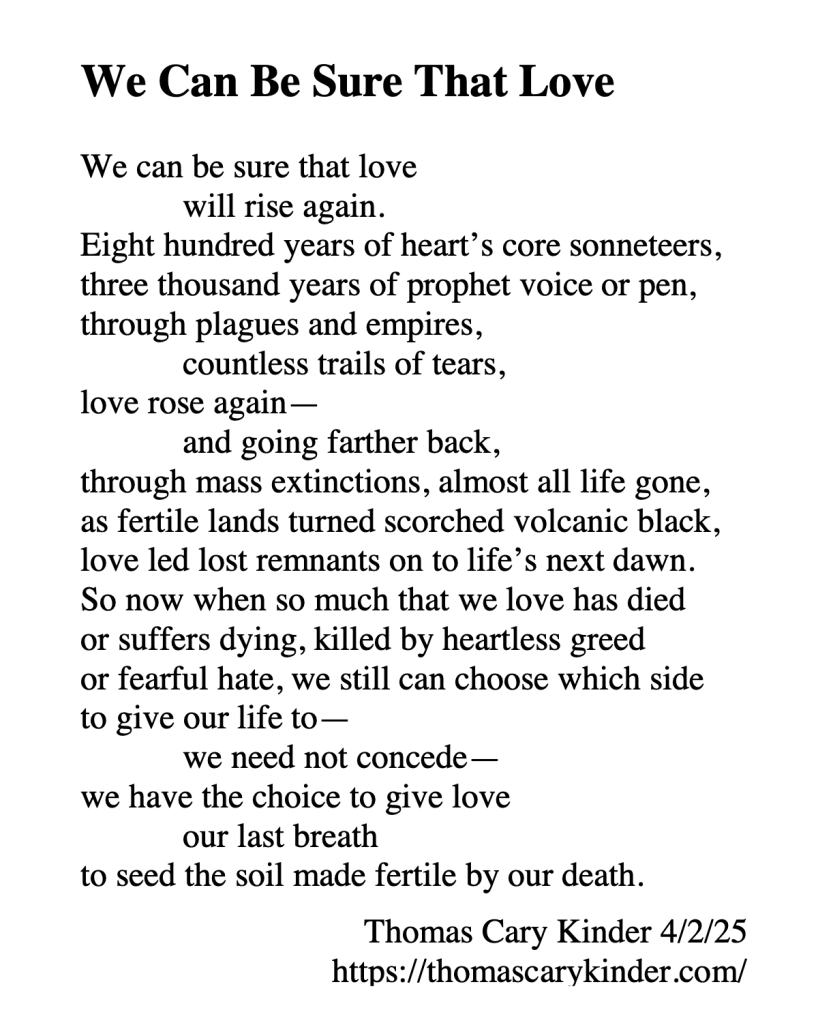
And now that imperfect but virtuous government is being torn down to the ground, and will love guide those who are doing the destruction as they govern? Will they create a more loving government for all? We may not know what is coming, but we do know, because history and personal experience have proven it, that love is the highest power on earth. We can be sure that love will rise again.
The text of the poem is below. This is a first draft, first take production. I am preparing books where each poem has been through many drafts, which is my inclination, but those could take years to be published. I feel compelled to share some of my daily poems each week because they speak to this time we are going through together. These words are coming straight from my heart in this moment, and I hope they provide some kind of gift to your heart. They help me to write. I hope they help you to read. And we sure need help, don’t we? This poem is about one place I find it.
Such Places
I climb this hill each day for sanity. It’s keeping me alive as so much dies. I find great comfort in this massive tree that has survived somehow, by storms made wise. I’m also humbled by the many signs of fellow creatures, up here to survive. Tossed leaves, dense tracks, their hungers’ zig-zag lines. We share this path. I’m glad we’re all alive. I’m glad that underneath the snow-packed leaves the deer and turkey find some nuts and seeds. I’m glad I find within this mind that grieves the deeper calm and wisdom our world needs. All plants and animals will soon be dead unless such places fill our heart and head.
Please honor the Tao or Spirit of creation and use your voice and actions courageously to build a wise and loving world.
Speeding Blindly Toward Doom Down a Dangerous Road
Out here, immersed in nature, we can see inherent worth in worms and trees and birds. We see as well our shared humanity, despite our different views, behaviors, words… so those who out of greed dehumanize the poor they rob or all who block their way, and who treat earth as if it is their prize for being rich, so nature must obey, sound stupid, dangerous, like utter fools who lack the common sense of any child who learns hot stoves will burn and other rules of higher powers that must be reconciled. Out here, we see our doom when we don’t know to honor Tao on roads of mud or snow.
This sonnet refers to ancient Taoist poets who fled their corrupt empire. I highly recommend David Hinton’s excellent book Mountain Home: The Wilderness Poetry of Ancient China. You can find a link for it below the poem text.
The ancient Taoist poets did take flight from empire’s deadly storms to mountain’s peace. That does not mean that they gave up the fight. In truth, it made their influence increase both there and then and through all realms and ages until today when evil has returned and persecutes descendants of those sages who still pursue the world for which they yearned, the all-inclusive love of Christ and Tao. Resistance rises in its timeless forms, and each of us who love are asking how we best can fight such fierce, enormous storms— some on the barricades, some underground, and some where peace and power of Tao are found.
These sonnets are first drafts written the week ending February 28, 2025. In the past I have always put poems through many drafts before sharing them, but I believe the relevance and urgency of the poems written in this time of crisis compensate for the roughness.
My friends, we have heroic work to do. The highest meaning life can have is ours if we lay down our lives to fight the few amassing wealth and using all their powers to bribe or brainwash or intimidate or crush or kill to stop the side of love for all who live. Our enemy is hate in any form that places one above and others far below an equal worth. We fight not for ourselves but what is right. We fight for all who share this fragile earth. We fight the darkness with the tools of light, not harming just as we would not be harmed, armed with a love that cannot be disarmed. 2/23/25
Our fear at how dehumanizing hate now has the power it needs to kill at will is urging us to run before too late, but love is whispering, “There is hope still.” Our rage at how hate treats the earth, the poor and all not Christian-hetero-male-white sparks thoughts of vengeful sabotage and war, but love is whispering, “Stay in the light!” We need to find a way to fight this wrong. We need to stand with all who are oppressed. At threat of death, may courage keep us strong to speak and act to show that we protest, to model worlds of love we seek to build, by force of light no hate has ever killed. 2/25/25
I need to rebuild strength before I fight because the last long struggle took my all. My father fought against the fascist right. Two ancestors helped bring about the fall of slavery and white supremacy— one lost an arm, one was imprisoned twice. They nearly died so strangers could live free, and now the stakes are worth far greater price— the fate of every creature on this earth, the fate of billions whom the few oppress. What is this loveliest of planets worth, its lives and loves beyond count we can guess? As soon as I can rise from my sickbed I’ll fight the side of death until I’m dead.
This is a sonnet first draft written on November 26, 2024, a few weeks after the election and a few days before I got covid, followed not long after by the flu. The long stretch of illness and recovery derailed my “Poem of the Week” series. This would have been the next in line, and it still speaks to where I am and what I feel called to do. Does it speak to you? If so, please leave a comment. I would be glad to hear how you are responding to this time.
I see two Scrabble signs at home each day: one “SAVOR;” and the other one “RESIST.” I see now they are callings to obey to fight totalitarians’ fierce fist. They suddenly have bought complete control, brainwashing innocents with hateful lies, exploiting fears, empowering every troll to swing its club until the nation dies, and sweet earth, too. So I am called to fight by savoring and loving what they’re killing, by letting that love guide me by its light, by quieting to sense what it is willing— love’s Tao or Spirit that wants life to thrive. Savor. Resist. It’s why I am alive. 11/26/24
I am so deeply grateful for the many, many people I know who are sacrificing their time and energy to canvass and phonebank and be poll watchers and volunteer in so many ways for the sake of democracy, equality and the saving of the nation and life on earth.
I have given more of my all to this election than all the prior elections combined, but now in the final days my job is to serve as pastor to my community, so I am intentionally seeking the deepest spiritual place I can attain, meditating several times a day, and spending as much time in nature as I can tear away from my pastoral work.
Today what came to me was enormous gratitude for all you who are working so hard for this cause, and the strange thing was that I felt the gratitude was greater than just mine. I felt I had connected in me with the spirit that is in all the living things around me here, and I wanted to say thank you on behalf of all those creatures that have no vote, thank you to all my friends in swing states and working at home to make the world safe for all species.
So this poem and short nature video are for you. We are all with you. The force of nature, the will of the earth is with you. Please feel its power and joy in everything you do, and keep pushing until the polls close!
Chief Oren Lyons asked the United Nations where was the four footed, where the eagle, why do they not have their own delegations? Excluding them cannot be right or legal by nature’s law—the law that judges all on how they treat all creatures and the earth. Fifty years ago now he gave that call and every day his words gain greater worth. A bobcat crossed my field the other day as I prepared my ballot for the mail. Her grace and beauty took my breath away, her powerful muscles, that mysterious tail. It was my legal signature I wrote, but hers the higher law, and hers my vote.
Friends, we are almost there—we are almost home, and that’s what today’s Poem of the Week is about (see below)! It’s really natural and even rational to get caught up in all the drama that is swirling around this election and to be feeling discouraged, disheartened or paralyzed by fear because of the fierceness of it and because of the stakes. (Read today’s 11/1/24 excellent free substack letters of Robert Reich and Heather Cox Richardson.)
We can’t let ourselves get paralyzed because we are almost home, and the saying is that a poll that is within the margin of error (as they all are) is within the margin of effort.
That’s what we need—we need to be giving all we have now for the next few days to get out the vote, everything we’ve got, and adding our voices to the growing joyful crowd endorsing Harris/Walz and Democrats.
In order to do that, we have to stay in the light, we have to keep positive and up, and there’s good reason to, so whatever works for you, wherever you find the light, please fill your vision with it now, and let’s take this baby home!
Here’s the poem, a stealth sonnet:
Coming home over Alger Brook we saw, just as we crested down from Blue Moon hill, this brilliant yellow poplar, like a flaw that flashes from a gem—that radiant thrill to see this candle flame where all was bare, and know our home was waiting in its light, and now when earth is shadowed with despair it gives the feeling life may yet get right, or that at least tonight we may find peace, the comfort of an evening by the fire, the quiet darkness, letting stress release, brief sweet fulfillment of earth’s deep desire, reminding us of all that we defend, the light at this long homeward journey’s end.
The text of this sonnet can be seen at the end of this reflection. You can download a pdf of the reflection and sonnet here: In All Things Thee to See reflection
This is a poem about seeing, both literally and, more importantly, figuratively—about where we focus our heart and mind and what truth we perceive.
How we see ourselves determines how we treat others, it determines our ethics, so it has enormous consequences in the world.
How we see the earth and our place in it determines how we treat other creatures and the ecosystems that support all life.
The Golden Rule, or loving your neighbor as your self, is at the heart of all the major religions and systems of ethics.
Loving your neighbor as your self requires having both a true perception and a healthy love of your self and the world.
Loving your neighbor as your self does not mean merely that you love your neighbor in the same way that you love yourself. It means waking up to the reality that you and your neighbor truly are one self in very slightly different manifestations.
Loving your self does not mean selfishness or self-infatuation or narcissism, because your true self is not your selfish ego. Your true self is the spirit of the universe that created you flowing through you, it is the part of you that every other created being shares.
Your self is not your self, it belongs to the universe. As Teilhard de Chardin saw, our self is not a part of the universe we own wholly, it is the whole of the universe that we own partly. (Pierre Teilhard de Chardin, Science and Christ (New York: Harper & Row, 1968), pp.12-13)
To love your self, then, is to love the whole universe that you share with every other self as one.
We see this truth by shifting our focus away from our old way of looking at our self.
The slogan of John the Baptist and Jesus is translated in most Bibles, “Repent, for the realm of God is at hand.” The word translated as repent is metanoia in the original Greek. In this context it means to expand the vision of our heart, mind and spirit to a new perspective that can see God’s realm of true oneness here on earth.
We have to let go of our old focus in order to have a new focus. We need to empty ourselves of the self-will and craving and clinging of our ego so that we can look more deeply at our true self and the true nature of the universe.
The Christian spiritual path calls this step kenosis, the Greek word used in the New Testament for self-emptying. Kenosis leads naturally to metanoia. When we empty ourselves of our false self the true self becomes unhidden.
The result of kenosis and metanoia is agape, the Greek word for a love that is God-like and Christ-like, that sees universal oneness and loves its neighbor as itself. Agape is not based on the worthiness of others, nor is it trying to make ourselves worthy, it is simply allowing the spirit of the universe to flow through us. It is what we were created to do.
We urgently need to let that spirit flow through us now because our world is in trouble.
Every time we practice expanding and deepening our vision, seeing ourselves and our world more truly, we are moving humanity a step closer to creating the realm of God on earth, a sustainable harmony grounded in justice, compassion and love, what my brother George calls a Golden Civilization.
It all starts with seeing—seeing what is golden in our hearts, and recognizing that same ember in all things.
In All Things Thee to See
A man that looks on glass,
On it may stay his eye;
Or if he pleaseth, through it pass,
And then the heav’n espy. from George Herbert’s “The Elixir”
My woodstove has a window in its door
because it warms the heart to watch the flames.
Right now, my vision through the glass is poor,
part glare, part soot. My eyes are playing games.
They seek my presence in the vague reflection,
or fixate on the dark, obscuring flaws.
I have to force my eye to shift direction
and choose to see the gold behind the gauze,
beyond this drawn-down blind that judging mind
can make of anything we crave or hate.
Surfaces hold us when what wait behind
are gifts of light upon a sacred grate.
Training my eye to see past its desire
I pass through glass and fill with golden fire.
The text of this sonnet can be seen at the end of this reflection.
A reader expressed some discomfort with this sonnet for two reasons. I realize that many if not most readers could have the same discomfort, so I will address it as a way to reflect on what usefulness I see in this poem. Before I do, though, I suggest you take two minutes to watch the video.
Their discomfort: On the one hand, wine and chocolate are not problems to them. On the other hand, guilt and shame are serious problems and this poem pushed those buttons.
The sonnet says,
he binged on wine and sinful chocolate cake,
helpless, possessed by fleshly appetite,
his one concern, the shape his flesh would take.
I realize that wine is not harmful for everyone and that chocolate cake may be “sinfully good” without being sinful in any other way. They happen to be problems for the character in the sonnet, but readers should interpret them merely as symbols of whatever similar substances, activities or thoughts have the same effect for them.
What is it in your life that hooks you and makes you think, say or do something that you know is not good for you? What makes you feel helplessly possessed by desire to some degree, however small? What swings your focus onto your ego or surface self? What makes you overly concerned about your appearance or any other superficial means toward feeling worthy of approval in others’ eyes or your own?
The last line talks about dirt, and that’s one of the jokes in this poem. You can see in the video that I am treating lightly and humorously this heavy and important spiritual topic. The poem is about the dirty little secrets we all have, the weaknesses, flaws and foibles we would rather hide. It is about throwing open the curtains and windows and letting light and fresh air get in to expose the dirt for what it is and then transform it.
The usefulness of the poem is exactly the opposite of making us feel guilt and shame. A good organic gardener will have weeds that need to be pulled. That is part of the job—dealing with a natural occurrence that is not bad, not sinful, not anything to feel guilty or ashamed about, but something that is counterproductive to a garden’s beautiful fruitfulness.
Every once in a while the weeds will get ahead of the gardener. That’s life. Again, it’s not an occasion for guilt or shame, but for understanding and compassion and, yes, if possible, a sense of humor.
Coleman Barks’ translation of the Rumi poem entitled “The Guest House” captures this delightfully. It ends:
The dark thought, the shame, the malice,
meet them at the door laughing,
and invite them in.
Be grateful for whoever comes,
because each has been sent
as a guide from beyond.
(Click here to read the entire short poem. If you don’t know it, I highly recommend it. It’s a treasure!)
So where is the “guide from beyond” in the sonnet, “Eradicating Endlessly,” leading us?
To have humility and accept the dirt and the unhealthy, unwanted plants that naturally keep sprouting in our very human humus.
And then to get down on our knees and pull more root.
It’s just part of the job of being a gardener, tending the growth of our true self, clearing the way for the Spirit so that we can fulfill our calling and use our gifts and our entire life to bear the fruit the universe needs of us.
The Greek word “kenosis” is what we call self-emptying in the Christian spiritual tradition. The concept is not exclusively or originally Christian—it is at the core of every contemplative path, every form of meditation, every process of seeking the oneness that is the most mature stage and state of human development.
If you want to grow horticulturally, you will need to practice weed-control; if you want to grow spiritually, you will need to practice self-emptying.
It will be a struggle sometimes, but as Swahili wisdom puts it, “celebrate the struggle!” You might as well greet the weeds laughing as they sprout in your soul.
You will probably reach your goal sooner if you can do it from a place of humor and compassion rather than guilt and shame. You will probably get more skillful more quickly at eradicating the dirty-secret thought-roots before they become action-fruits if you are not also having to eradicate the more pernicious ego-weeds that stem from taking yourself too seriously or pridefully.
I hope this sonnet will help you remember to do your work cheerfully, or at least to do your work! And I hope you will find it useful to remember that you are not alone in that garden. We’re on our knees right alongside you, day in and day out, and will be forever, celebrating the struggle. Happy eradicating!
Eradicating Endlessly
He meant to write about a sick plant’s death,
and how he pulled its roots up from the pot,
and how the hole it left inhaled fresh breath
and gained new life, refilled with rich, dark rot.
He thought to symbolize his ego’s rout,
how he effected its eradication
and nurtured his true self—aversion, doubt,
attachment, gone! A fertile, new creation!
He would have written that, except last night
he binged on wine and sinful chocolate cake,
helpless, possessed by fleshly appetite,
his one concern, the shape his flesh would take.
His worst self sprouts another fat, pale shoot.
His hand sinks back in dirt to pull more root.
The text of this sonnet can be seen at the end of this reflection.
Epiphany comes from an ancient Greek word meaning to reveal. When we say we have had an epiphany we mean the recognition of a truth that has suddenly been revealed to us, an “aha!” moment. The church season after Christmas is called Epiphany because it celebrates God’s presence on earth revealed not only in Jesus but also in the manifestations of light we can see in all people and all nature.
Humanity needs both kinds of epiphanies right now as we search for a way forward through a world that has been made strange to us by our own actions.
We need to see new truths, and we need to see ancient truths anew. We need to shape a new story out of the old, expressing a new understanding of our place and purpose in the universe. Following our old story, our society has become polarized, our earth unstable, greed out of control. Racial, economic and environmental injustice are bringing society to the point of upheaval. And yet the heart of the old story has truth in it that we need to carry forward.
The violent riot that smashed its way into the United States Capitol Building on January 6, 2021 carried signs, shouted slogans and blasted music that identified it as a white supremacist, fundamentalist, Christian-nationalist event.
The New Yorkerpublished footage taken by journalist Luke Mogelson from the midst of the insurrection that he filmed with his phone. Continue reading →
Everyone can feel joy at Christmas no matter what their spiritual path because we celebrate the birth of a human who attained the highest stage and state of human consciousness, who embodied the oneness with all creation, the universal compassion and love of neighbor that flow from a fully evolved and mature heart and mind.
He saw from his advanced consciousness that anyone could attain this maturity, that humanity could someday get there as a whole and society be characterized by oneness, compassion and love. He called it the realm of God on earth, life in harmony with the spirit of the universe, and he said we were close to getting there.
The reason everyone can feel joy during Advent is that it prepares us to have that same heart and mind. This is the advent we are seeking and now we are two thousand years closer.
That enlightened human urged us to undertake the journey, and he taught us how. .
The future of human civilization and all living beings depends on this shift to a new sustainable, just and harmonious life on earth happening as quickly as possible. We will not survive long without attaining this new consciousness.
That is why Advent and Christmas are such gifts, because if we immerse ourselves in the spiritual journey they map out it will lead to our transformation and the transformation of the world.
Below are three reflections and sonnets for the final days of Advent leading up to Christmas. I hope they help you on your journey and help you undergo the next transformation the Spirit needs you to make. I hope they increase the love and light you shine to transform the world around you.
The Buddhist philosopher Ken Wilber says that one of the things that helps us on the journey toward the most mature level of consciousness is simply knowing that it is there to be attained, and that we are created and called to strive for it. No matter what our age or situation in life, we can move toward it, and it is one of the most important things that we can do for the world.
Madeleine L’Engle, the author of Wrinkle in Time and sixty other books, wrote a profoundly wise one entitled Walking on Water: Reflections on Faith and Art. In the passage below she talks about Mary the mother of Jesus as a model for how artists respond to their calling, but I encourage you to broaden the meaning to be about any person with any calling—including the important tasks life is asking of you now. Understand that when this passage says artist it means you, whatever your gifts may be:
“The artist is a servant who is willing to be a birthgiver. In a very real sense the artist (male or female) should be like Mary who, when the angel told her that she was to bear the Messiah, was obedient to the command….
“I believe that each work of art, whether it is a work of great genius, or something very small, comes to the artist and says, ‘Here I am. Enflesh me. Give birth to me.’ And the artist either says, ‘My soul doth magnify the Lord,’ and willingly becomes the bearer of the work, or refuses; but the obedient response is not necessarily a conscious one, and not everyone has the humble, courageous obedience of Mary….
“What would have happened to Mary (and to all the rest of us) if she had said No to the angel? She was free to do so. But she said, Yes….
“Mary did not always understand. But one does not have to understand to be obedient. Instead of understanding…there is a feeling of rightness, of knowing—knowing things which we are not yet able to understand.” (pp 18 ff)
Believe There Can Be Fulfillment
“Blessed is she who believed that there would be a fulfillment of what was spoken to her by the Lord.” Luke 1:45
“Blessing always comes from trusting that God’s Word will be fulfilled.” Alan Culpepper in the New Interpreter’s Bible Commentary on this verse
We each are born with our own Mary womb.
We all have gifts that come down from above,
or up from deep within—our Golden Room,
our greatest height and depth, our source of love
and life and light within our spirit’s heart
where truth and beauty rise, a hidden spring
that flows with what is our own form of art,
of bearing Christ, of Mary mothering.
The question is, do we believe that Word?
Even to hear it takes some faith, some trust,
but do we trust enough once we have heard
to act upon it, feeling that we must,
believing in this blessing God has willed
of gifts to share, Christ’s love through us fulfilled?
Advent calls us to wait and watch and pray, to make a contemplative journey through the darkness in preparation for the coming light.
If we take Advent as a time of inner reflection we are likely to see some unpleasant things about ourselves that are hidden in our darkest shadows. We need to face them as part of our preparation for spiritual growth to a new level of consciousness.
Thomas Keating writes about this in his classic introduction to Centering Prayer, Open Mind, Open Heart. “Our so-called good intentions look like a pile of dirty dishrags. We perceive that we are not as generous as we had believed. This happens because the divine light is shining brighter in our hearts. Divine love, by its very nature, accuses us of our innate selfishness.”
Mary serves as a model of how we can be transformed so that love and light can transform the world through us, and it can be discouraging or even downright depressing in Advent when our inner reflections or outer challenges show us how flawed we are compared to her.
The 20th Century Catholic monk, Thomas Merton, said that the perception of Mary as an exalted object of reverence can be misleading and unhelpful. The reason she is highest, he says, is because she is lowest, having the humility and peace “without which we cannot be filled with God.”
Merton says that Mary’s greatest glory is that she “in no way resisted [God’s] love and [God’s] will… She was free from every taint of selfishness that might obscure God’s light in her being…. [She was] as pure as the glass of a very clean window that has no other function than to admit the light of the sun.” (New Seeds of Contemplation, pp 167-175)
Our calling is to be like Mary as much as we can, but Thomas Keating understood that we do not have to wallow in our flaws, nor do we have to spend years of arduous asceticism, scrubbing our fingers to the bone to purify our panes of glass. All we have to do is let go and return our focus to a simple consent to God’s loving and transforming presence within us.
If we turn our flawed hearts and minds to the light, the light will prepare us for the transformation we seek.
Preparing the Stable
For you to have your birth in this old stable
I need to free up one sufficient stall
and make it clean, as much as I am able:
freshen the bedding; scrub down every wall.
To make of it a Christly habitat
it must be humble, full of love and true,
a place as welcoming to goat or rat
as Spirit made flesh, pure of heart, born new.
But my old habits fight the change I need,
foul matted dung and straw built up for years,
flawed manger, gnawed where my addictions feed,
failed whitewash painted by my shames and fears.
Lost in despair, I look to your star’s light.
When I look back, my stall is clean and right.
Advent was invented as a spiritual journey through a time of darkness when we watch and wait and pray in preparation for the coming of the light.
This time of year is emotionally challenging for many people under the best of circumstances. Advent 2020 is excruciating for millions more who are affected by the pandemic and the glaring economic, racial and environmental injustices that it has only made worse. The usual comforts of the season are largely unavailable to us, making the darkness feel harder.
And yet in the wisdom of our tradition, as we enter the very darkest days, Advent gives us Gaudete Sunday, the third Sunday of Advent when we light the candle of Joy.
The easy and culturally popular approach to Advent is to practice denial of the darkness, focusing all season on the glittering lights and festive pleasures of Christmas. This is understandable, but it misses the central point of Advent and the transformative wisdom we need right now: joy comes not in spite of the darkness but as a result of our faithful journey through it.
The truth is that we live much of our lives in the dark. The beauty of the night appears only when our eyes have adjusted. Then we can see the stars behind the stars, and the light that shines in the darkness that the darkness does not overcome.
Seeing in the Dark
It was drizzling. The little bit of snow was melting. It was two weeks before Christmas, a dark, dreary afternoon. I was worried about people I love who are suffering from severe depression. I was feeling depressed myself. It had been the hardest and darkest of Advents.
I drove around the bend in the dirt road and our mailboxes came in view, a collection of different shapes and sizes ranging from a shiny stainless steel replica of a sugarhouse to my own green-paint-over-rust veteran of many winters.
I gasped. Someone in the neighborhood had hung beautifully arranged evergreen branches with bright red bows on the two weather-beaten posts holding up the boxes.
A smile covered my worried face like fresh snow and the song “Good King Wenceslas” sprang from the darkness within me. I tacked up a note, “Thank you, wonderful neighbors!”
The intention, I later learned, was “to share some light and hope” in a dark time. It worked. I carried that joy all the way home and through the night.
It worked for the neighbors who gave me that gift, too. Advent leads us to the wisdom that acts of love and compassion toward others give us joy as we give joy to them.
The Wisdom of Joy in the Darkest Places
The wisdom of Viktor Frankl comes to us from his suffering in Auschwitz, one of the densest darknesses of the Nazi holocaust. He wrote, “As the inner life of the prisoner tended to become more intense, he also experienced the beauty of art and nature as never before….
“We were at work in a trench. The dawn was grey around us; grey was the sky above; grey the snow in the pale light of dawn; grey the rags in which my fellow prisoners were clad, and grey their faces…. I was struggling to find the reason for my sufferings, my slow dying. In a last violent protest against the hopelessness of imminent death, I sensed my spirit piercing through the enveloping gloom. I felt it transcend that hopeless, meaningless world, and from somewhere I heard a victorious ‘Yes’ in answer to my question of the existence of an ultimate purpose. At that moment a light was lit in a distant farmhouse, which stood on the horizon as if painted there, in the midst of the miserable grey of a dawning morning in Bavaria. ‘Ex lux in tenebris lucet’—and the light shineth in the darkness…” (Man’s Search for Meaning p59f)
Tutu suffered with his people under the brutal violence of apartheid. His prostate cancer had returned as they were writing the book.
The Dalai Lama fled into exile as the Chinese invaded his beloved Tibet murdering many of his people and crushing their cultural and spiritual heritage. He has lived with the grief of continuing traumas for decades.
Yet both of these men shine a joyous light around them.
They credit the same wisdom that Viktor Frankl discovered in Auschwitz. One day the thought of Frankl’s wife came to him in a moment of intense suffering. He did not know that she had already died in another death camp at age 24. He knew she could be dead, but she was alive and vividly present in his mind. He wrote of that moment,
“A thought transfixed me: for the first time in my life I saw the truth as it is set into song by so many poets, proclaimed as the final wisdom by so many thinkers. The truth—that love is the ultimate and the highest good to which [humanity] can aspire…. The salvation of [humanity] is through love and in love. I understood how a [person] who has nothing left in this world still may know bliss…” (p57)
The Dalai Lama and Desmond Tutu book on joy has a chapter entitled, “Nothing Beautiful Comes without Some Suffering.” The book has sections on fear, stress, anxiety, frustration, anger, sadness, grief, despair, adversity, illness and death. These themes may seem strange in The Book of Joy, but both men insist that the darkness not only cannot destroy joy, but it provides a path to it.
They see that love is the key, in its many dimensions. Their “Eight Pillars of Joy” include humility, forgiveness, gratitude, compassion and generosity, as well as humor, perspective and acceptance.
The third and fourth Sundays of Advent traditionally are Joy and Love. The Taoist symbol expresses their relationship to one another, as it does the relationship between darkness and light, and also, perhaps, between a mother and the child in her womb.
Advent Wisdom from the Womb
Lisa Kutolowski of Metanoia of Vermont wrote a beautiful Advent reflection on her journey through the darkness of wanting a baby but being unable to conceive. She writes, “By fully entering the pain of my unmet longing, I received the ability to more freely love my future child. I am exceedingly grateful for this time of waiting. Its fruits are the greatest gift I can imagine giving to Anna…. I am certain that more months or years of waiting would have revealed more layers of attachment and with those revelations, more gifts.”
Lisa ends with this profound insight: “It is essential we are honest about the pain of waiting. Without this honesty, we will find ways to skirt around the pain – avoiding, distracting, deflecting. This attempt to escape feeling the pain almost always transfers the pain to someone else. We seek security, wealth, or pleasure at the expense of someone else and ultimately, millions of people’s unacknowledged pain leads to entangled systems of injustice. Additionally, if we can’t look our personal pain in the face, how can we take an honest look at the grave injustices and inequities in the world? If we can’t acknowledge the pain of our personal unmet longing, how will we ever be free to hear the cry of the poor and the disinherited?”
The Darkness Is Our Teacher
Lisa’s pain became her teacher. The Dalai Lama has said that the Chinese were his greatest teachers. This can be true of all our struggles. The darkness we pass through teaches us much about light that we could not learn to see otherwise.
The Dalai Lama said, “If you want others to be happy, practice compassion. If you want to be happy, practice compassion.”
In that spirit, here are two Advent sonnets written from within my own darkness. I hope they lead you to compassion and lovingkindness for others and yourself, and to the joy of keeping faith with the Advent journey.
Advent’s Darkest Depths of Silence
The angel said to him, “Do not be afraid, Zechariah… Your wife Elizabeth will bear you a son, and you will name him John…. Zechariah said to the angel, “How will I know that this is so? For I am an old man, and my wife is getting on in years.” The angel replied, “I am Gabriel. I stand in the presence of God, and I have been sent to speak to you and to bring you this good news. But now, because you did not believe my words, which will be fulfilled in their time, you will become mute, unable to speak, until the day these things occur.” Luke 1:13-20
Old Zechariah, tongue clamped dumb from doubt—
at least he got to watch her belly swell.
He saw just how his crisis would come out,
how he would have a greater hope to tell
than ever he had dared to think or dream.
He saw the advent that his love was bearing.
He never wondered, are things as they seem?
The angel’s word, proved, kept him from despairing.
In my tongue’s drought, when words wilt, lifeless dust,
when nothing sprouts, no swelling of gestation,
I do my temple tasks, enacting trust.
I pray, write, preach, tend souls, my called vocation,
but get no sign of dawn or worth or child,
just darkness—doubt and faith unreconciled.
Advent of the Christ Self
What was in Mary just before the light,
the voice of Gabriel, the power of God,
came filling all of her—heart, womb and sight?
This morning I am hoping she was flawed,
and not the perfect vessel others claim.
I need to think of her as sad and yearning
for something she perhaps could not yet name,
an aching emptiness where she kept turning,
searching within the lightless void inside
and feeling devastation in the loss
of what she did not find. She prayed and cried
and felt forsaken on her longing’s cross—
sometimes self-loathing, sometimes mere self-doubt
until the Christ self filled her lost self out.
Advent is designed to be a path of inner and cultural transformation through darkness into light. Other spiritual traditions have parallel paths.
Finding and taking a path like Advent to inner transformation is urgent for us each because cultural transformation is now urgent for us all.
I quote Gus Speth over and over because our one hope for survival as a nation and species is that we place his wisdom at the top of our individual life goals and daily priorities:
“Many of our deepest thinkers and many of those most familiar with the scale of the challenges we face have concluded that the transitions required can be achieved only in the context of what I will call the rise of a new consciousness.” (from his book, The Bridge at the Edge of the World: Capitalism, the Environment, and Crossing from Crisis to Sustainability)
This post is a continuation of my poems and reflections on Advent. Advent’s path progresses along a series of themes. The first Sunday is hope, and the second peace. They are followed by joy and love and finally the light of transformed spiritual consciousness represented by Christ: humanity fully evolved and matured.
Jesus looked at a society that was in many ways like ours and said, “If only you had recognized the things that make for peace!” (Luke 19:42)
The Hebrew word shalom means peace in the fullest sense of harmony, wholeness and wellbeing—both peace and the conditions that make for peace. True shalom requires a mature, transformed heart and mind capable of recognizing the oneness of all people and all the earth and therefore acting with compassion and justice for all.
Advent calls us to shalom and adds to it the wisdom of Taoism:
No peace in the world without peace in the nation;
No peace in the nation without peace in the town;
No peace in the town without peace in the home;
No peace in the home without peace in the heart.
The Eastern Orthodox saint, Seraphim of Sarov, put the same principle this way: “Have peace in yourself and thousands will find salvation around you.”
How can we find the peace and things that make for peace that we urgently need? Below are three sonnets that reflect on this question.
[The words of this Advent sonnet are printed below.]
The season of Advent represents the most urgently important wisdom the Christian tradition has to teach us right now. It holds the key to the spiritual transformation that we need in order to heal our divided and damaged world.
The word “advent” means the approach or arrival of something. The season of Advent gives us metaphors to understand our current limited vision and way of being as a kind of darkness, and the more developed, mature heart and mind of Christ as a kind of light that can be born within us.
The season of Advent is about preparing to receive this transformation by opening our hearts and minds to the light as widely and purely as we can so that it will fill us and shine through us into the world.
We can seek and find the light in nature, or in art, or in the vulnerable, hurting or oppressed people and earth that we turn to with compassion and a helping hand, but in order to find light outside of ourselves we need to prepare to find it within ourselves. Continue reading →
[The words of this sonnet about Grace Paley are printed below. It is closely connected to another poem and reflection on this site, “In the Shadow of Absence” that you can see by clicking here. It also relates to a recent sermon, “My Feets Is Tired but My Soul Is Rested” that you can see here.]
All Saints Day approaches. One way to define saint is as a hero who also is a great soul. This poem is about Grace Paley who would have laughed at being called a saint. She was a true hero, though, and more than once she was called a great soul. I think it honors the name “saint” to call her one.
We are at a moment of history that needs heroes and great souls. We have no time to wait for them to appear. We need to be them ourselves.
Some feel we need one great leader to emerge, but the world needs every hero and great soul it can get. We don’t have to worry about being just ordinary people. Most heroes and saints have been so only because the moment required it of them and they rose to meet its need.
We have a task that is of the highest priority. It will take us all giving our all to accomplish it. It will also take a cultural change of consciousness, maturing to a new Enlightenment, in order to have the wisdom, commitment and courage we need.
Elections are part of the task, Friday climate strikes and Black Lives Matter protests are part of it, the Poor People’s Campaign and all the liberation movements—they are different means to reaching the same goal, a world that is livable, lovable, sustainable and worth giving our all to save.
David Attenborough has produced an extraordinary film, David Attenborough: A Life on Our Planet, that includes both his witness to the existential crisis that humanity has created and his vision of how we could still change course and reverse the damage and restore the stable planet that humanity has enjoyed for millennia. (You can see the film’s trailer below and find ways to watch it on YouTube or Netflix.)
His perspective is specifically focused on the biodiversity that we are rapidly destroying without which we may well become extinct, but the hopeful task he gives us is essentially the same in every crisis of injustice and abuse that we face, whether social, economic or environmental. Whatever issue concerns you most, listen to his words and see how they apply: Continue reading →
This sonnet is a little parable about two monks, a novice and a master sage. It can be read literally, or you could see the master sage as anyone or any situation in your life that challenges you. The poem speaks to all forms of suffering that we transform into wisdom over time.
[The words of this sonnet are printed below. It relates to another sonnet on this site and its reflection, Judging at the Ox Pull.]
Greta Thunberg believes that humanity is unable to address the climate crisis because we do not yet have the level of consciousness we need to change civilization as much as we must. She puts it this way, “To get out of this climate crisis, we need a different mindset from the one that got us into it.”
The same could be said of any crisis, personal as well as global.
Greta echoes the wisdom of Albert Einstein who said, “The unleashed power of the atom has changed everything save our modes of thinking and we thus drift toward unparalleled catastrophe…. A new type of thinking is essential if [humanity] is to survive and move toward higher levels.” (New York Times – May 25 1946, p.13 – ‘Atomic Education Urged by Einstein’)
The poem “Unbroken Prayer” is a parable about attaining a new level of consciousness that is able to resolve and move beyond obstacles that we have not been able to overcome. On its surface it describes an evolutionary inner path that spiritual sages of all traditions have found and mapped, the contemplative path, traveled by means of meditation and mindfulness practices and spiritual friendship.
Greta has come to this “different mindset” by another path. She says, “People like me – who have Asperger’s syndrome and autism…. see through the static.”
It is urgently important that we find a path beyond the way of thinking and living that has led to the crises that now threaten to destroy the ecosystems on which all life depends and the democracies that have aspired to ever greater freedom, equality and justice.
We need the dominant culture of human civilization to evolve, and that will take millions of individuals who can “see through the static”—the static of the self as well as the static of our current culture—millions who rise like the novice in the poem to act from an enlightened heart.
The spirit of life has guided evolution over billions of years from the simplicity of the first single-celled prokaryotes to the complexity of the human mind. It doesn’t matter whether you think of that spirit as a personal God or as a set of laws—what matters is that the same sense of direction that has guided life to this moment is within us each now, and it clearly wants to point its creations in the direction of survival and ever greater life.
It is not just a higher power, it is the highest power within and around us.
The highest power in the universe wants to help us find our way through the crises and obstacles we face, so the most important thing we can do now is connect to that power and listen to its guidance. We can find the strength we need in it to enable us to serve its purpose with our every thought, act and gift.
The last words of the sonnet are “Stay there.” It means to stay connected to that power in whatever you do, to live from the new mindset it gives you, and to work from that transformed consciousness to transform the world.
In other words, it means to live in unbroken prayer.
Unbroken Prayer
When he would come across the novice praying
the master sage would prod him with his cane
and tell him they had bills that needed paying
or order him to go unplug a drain.
The novice knew that this was just a test.
Still, to be deep and yearning toward the goal,
his sacred calling, then be poked and stressed—
he felt rage surge that he could not control.
For years he suffered the indignity
of watching as his worst self would arise,
but slowly he gained equanimity,
and welcoming his weakness, he grew wise.
One day he rose within unbroken prayer.
The master said, “No, I will go. Stay there.”


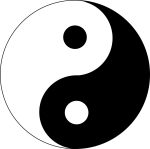 The third and fourth Sundays of Advent traditionally are Joy and Love. The Taoist symbol expresses their relationship to one another, as it does the relationship between darkness and light, and also, perhaps, between a mother and the child in her womb.
 Thomas Cary Kinder